GLOBAL ACADEMY INSTITUTE OF TECHNOLOGY FOUNDATION, INC. (GAITF)
INSTITUTIONAL POLICY ON LEARNING MANAGEMENT SYSTEM (LCMS) UTILIZATION, INSTRUCTIONAL PREPARATION, LEARNING DELIVERY, AND OUTCOMES-BASED EDUCATION (OBE)
Policy No.: GAITF- AP-001-2022
Implementing Office: Office of the Executive Director / Academic Affairs
Coverage: All Teaching Personnel, Academic Coordinators, Trainers, and Instructors
Effectivity: Starting School Year 2022-2023
Review Period: Annually or as necessary
ARTICLE I. GENERAL PROVISIONS
Section 1. Title
This policy shall be known as the GAITF Institutional Policy on Learning Management System Utilization and Outcomes-Based Education Learning Delivery.
Section 2. Rationale
The Global Academy Institute of Technology Foundation, Inc. (GAITF) recognizes that effective teaching requires systematic instructional preparation, appropriate learning resource development, meaningful classroom engagement, continuous assessment, and measurable learning outcomes.
In pursuit of quality education, GAITF adopts an Outcomes-Based Education (OBE) approach that places emphasis on what students are expected to know, understand, demonstrate, and accomplish upon completion of an instructional unit, subject, course, or training program.
The GAITF Learning Content Management System (LCMS) serves as the institution’s official digital instructional platform for organizing learning resources, distributing instructional materials, facilitating learning activities, administering assessments, monitoring student progress, and maintaining academic documentation.
The institution has observed the importance of strengthening faculty compliance with the systematic preparation and utilization of instructional materials and the appropriate documentation of teaching and learning activities.
Accordingly, this policy establishes minimum professional and instructional standards for all teaching personnel, whether instruction is conducted through face-to-face, online, blended, or other approved learning modalities.
Section 3. Objectives
This policy aims to:
- Institutionalize the use of GAITF LCMS as the official instructional support and learning resource management platform.
- Strengthen the implementation of Outcomes-Based Education in all academic and technical-vocational programs.
- Establish minimum instructional preparation requirements before every class session.
- Ensure that teachers provide appropriate learning resources, instructional activities, and assessment instruments.
- Promote systematic monitoring, evaluation, and documentation of student learning outcomes.
- Improve instructional accountability and professional responsibility among teaching personnel.
- Establish a standardized process for identifying students who require remediation, reinforcement, or enrichment.
- Encourage continuous improvement through instructional reflection, peer collaboration, and academic supervision.
- Ensure that instructional resources remain accessible, organized, updated, and aligned with approved curriculum requirements.
- Strengthen institutional quality assurance and academic performance monitoring.
ARTICLE II. SCOPE AND APPLICATION
Section 1. Covered Personnel
This policy shall apply to:
- Regular and part-time teachers.
- Subject teachers and academic instructors.
- Senior High School teachers.
- Technical-vocational education and training (TVET) trainers.
- TESDA program instructors and assessors, where applicable.
- Academic coordinators and program heads.
- Other personnel assigned instructional responsibilities.
Section 2. Covered Learning Modalities
The policy applies to:
- Face-to-face classroom instruction.
- Online synchronous instruction.
- Online asynchronous instruction.
- Blended learning.
- Laboratory and workshop instruction.
- Competency-based training.
- Practical demonstrations and performance-based learning.
- Other institutionally approved learning delivery arrangements.
Section 3. Official Instructional Platform
GAITF LCMS, accessible through:
shall serve as the institution’s official digital platform for instructional resource management and learning delivery support.
Teachers shall use the platform to organize, distribute, and document relevant instructional resources and learning activities.
Other digital tools may supplement instruction but shall not automatically replace the institutional requirement to maintain appropriate instructional documentation in GAITF LCMS.
ARTICLE III. INSTRUCTIONAL PREPARATION REQUIREMENTS (BEFORE CLASS)
Section 1. Curriculum and Instructional Alignment
Before conducting instruction, every teacher shall ensure that the planned lesson is aligned with:
- Approved curriculum and course syllabus.
- Program learning outcomes.
- Course or subject learning outcomes.
- Unit and lesson learning objectives.
- Applicable DepEd, TESDA, or other relevant standards, where required.
- Institutional academic policies and quality standards.
Learning objectives must be specific, measurable, attainable, relevant, and appropriate to the instructional period.
Teachers are encouraged to use Bloom’s Taxonomy and appropriate competency-based learning principles in developing learning objectives.
Section 2. Required Instructional Preparation Documents
Every teacher shall maintain the following instructional preparation documents, as applicable:
A. Planning Documents
- Curriculum map.
- Course syllabus or training plan.
- Daily or weekly lesson plan.
- Instructional delivery plan.
- Learning objectives and expected outcomes.
- Lesson schedule and activity timeline.
- Differentiated instruction strategies.
- Learning intervention plan.
B. Instructional Materials
- PowerPoint or other presentation materials.
- Learning modules and handouts.
- Reading materials and references.
- Worksheets and activity sheets.
- Demonstration videos and instructional media.
- Laboratory and workshop activity guides.
- Case studies and problem-solving exercises.
- Simulation activities and practical exercises.
- Learning guides and competency-based materials.
C. Assessment Preparation
- Diagnostic assessment instruments.
- Pre-test questionnaires.
- Quizzes and examination materials.
- Performance tasks.
- Assessment rubrics.
- Observation checklists.
- Practical demonstration assessment tools.
- Answer keys and scoring guides, where appropriate.
Section 3. GAITF LCMS Preparation Requirements
Teachers are required to upload, organize, or make available the appropriate instructional resources in their assigned GAITF LCMS courses.
At a minimum, the following should be provided:
- Course or subject orientation.
- Course syllabus or learning guide.
- Learning objectives and expected outcomes.
- Learning modules or instructional references.
- Presentation materials or equivalent instructional resources.
- Learning activities and exercises.
- Assessment activities and evaluation instruments.
- Relevant supplementary references.
Instructional materials must be organized by subject, module, unit, competency, or learning topic.
Teachers shall ensure that materials are accessible to their enrolled students before the scheduled learning activities whenever practicable.
Section 4. Instructional Readiness
Teachers shall not enter a scheduled instructional session without reasonable preparation of the materials, activities, and assessment methods necessary to achieve the intended learning outcomes.
Preparation must include consideration of:
- Students’ prior knowledge.
- Individual learning differences.
- Available instructional facilities.
- Equipment and learning resources.
- Safety requirements.
- Anticipated learning difficulties.
- Appropriate instructional strategies.
ARTICLE IV. INSTRUCTIONAL DELIVERY REQUIREMENTS (DURING CLASS)
Section 1. Effective Learning Delivery
Teachers shall implement instructional strategies that promote active student participation, critical thinking, collaboration, problem-solving, creativity, and practical application.
Instruction shall not be limited to lectures, reading assignments, or presentation of information.
Learning activities must provide students with opportunities to demonstrate their understanding and application of the intended competencies.
Section 2. Minimum Instructional Delivery Components
Every instructional session should incorporate the following components, as appropriate:
- Introduction and Motivation – Establish the relevance of the lesson and connect it with previous learning.
- Presentation of Learning Objectives – Communicate what students are expected to accomplish.
- Activation of Prior Knowledge – Determine students’ existing understanding.
- Lesson Development – Explain and demonstrate essential concepts and skills.
- Guided Practice – Provide supervised opportunities to practice.
- Collaborative Learning – Encourage peer interaction and teamwork.
- Independent Application – Allow students to demonstrate individual understanding.
- Formative Assessment – Check learning progress during instruction.
- Feedback and Clarification – Address misconceptions and learning difficulties.
- Synthesis and Generalization – Summarize key concepts and applications.
- Assignment or Learning Extension – Provide appropriate activities for continued learning.
Section 3. Integration of GAITF LCMS During Instruction
Teachers are encouraged to integrate GAITF LCMS into classroom activities through:
- Accessing assigned learning modules.
- Conducting online quizzes.
- Distributing learning activities.
- Providing supplementary instructional resources.
- Assigning digital exercises.
- Collecting student outputs.
- Facilitating asynchronous learning.
- Providing announcements and academic instructions.
- Monitoring learning participation and completion.
For face-to-face instruction, LCMS activities may be conducted before, during, or after the classroom session depending on the nature of the lesson and available facilities.
Section 4. Student Engagement and Participation
Teachers shall establish appropriate mechanisms for monitoring student participation.
These may include:
- Attendance and participation records.
- Recitation and classroom discussion.
- Group activities.
- Individual exercises.
- Laboratory participation.
- Demonstration activities.
- Digital learning engagement.
- Practical performance.
ARTICLE V. POST-INSTRUCTIONAL REQUIREMENTS (AFTER CLASS)
Section 1. Assessment and Evaluation
Following every instructional session or learning unit, teachers shall undertake appropriate assessment activities to determine whether students have achieved the intended learning outcomes.
Assessment methods may include:
- Written examinations.
- Online quizzes.
- Practical demonstrations.
- Performance-based assessments.
- Project-based outputs.
- Laboratory reports.
- Oral presentations.
- Portfolio assessments.
- Case study analysis.
- Competency demonstrations.
- Reflection activities.
- Exit tickets and learning checks.
Section 2. Recording of Student Performance
Teachers shall maintain accurate and updated student assessment records.
These records should include:
- Attendance.
- Assessment scores.
- Activity completion.
- Performance task results.
- Practical competency ratings.
- Project submissions.
- Learning progress.
- Identified learning difficulties.
- Intervention and remediation records.
Where applicable, results and learning activities shall be recorded in GAITF LCMS and the institution’s authorized academic information systems.
Section 3. Timely Feedback
Teachers shall provide constructive, meaningful, and timely feedback.
Feedback should identify:
- What the student has accomplished.
- What aspects require improvement.
- Specific errors or misconceptions.
- Recommended corrective actions.
- Opportunities for additional practice.
Feedback must be constructive and intended to improve student learning rather than merely communicate grades.
Section 4. Remediation and Enrichment
Students who have not achieved the expected learning outcomes shall be provided with appropriate remediation.
Possible interventions include:
- Additional instructional sessions.
- Simplified learning materials.
- Individualized exercises.
- Guided practice.
- Peer-assisted learning.
- Additional demonstrations.
- Reassessment activities.
Students who demonstrate mastery may be provided with enrichment activities, advanced exercises, research tasks, or more complex performance challenges.
ARTICLE VI. TEACHER REFLECTION AND CONTINUOUS IMPROVEMENT
Section 1. Instructional Reflection
Every teacher shall periodically evaluate the effectiveness of instructional delivery.
Reflection shall consider:
- Whether the intended learning objectives were achieved.
- Whether the selected teaching strategies were effective.
- Whether the instructional materials were appropriate.
- Whether the assessment methods measured the intended competencies.
- Whether students actively participated.
- What difficulties were encountered.
- What instructional improvements are necessary.
Section 2. Instructional Improvement Records
Teachers are encouraged to maintain:
- Lesson reflection journals.
- Student performance analysis.
- Assessment result summaries.
- Remediation records.
- Peer observation feedback.
- Instructional improvement plans.
Section 3. Use of Assessment Data
Teachers shall use assessment results to identify learning gaps and adjust subsequent instructional activities.
For example, if a significant number of students fail to demonstrate mastery of a particular competency, the teacher shall review the instructional approach, learning materials, and assessment instruments before proceeding to more advanced competencies.
ARTICLE VII. MANDATORY UTILIZATION AND ACCOUNTABILITY OF GAITF LCMS
Section 1. Institutional Requirement
The utilization of GAITF LCMS is an institutional instructional requirement for all covered teaching personnel.
Teachers shall not treat the platform as an optional resource or use it only when specifically instructed by an academic coordinator.
Its use is an integral component of instructional preparation, learning resource management, assessment documentation, and continuous improvement.
Section 2. Minimum Teacher Responsibilities
Every teacher shall:
- Access their assigned GAITF LCMS account.
- Maintain their assigned courses and learning spaces.
- Upload and organize appropriate learning resources.
- Provide students with access to instructional materials.
- Use appropriate digital learning activities.
- Administer or support assessments through the platform where applicable.
- Monitor student participation and learning progress.
- Provide feedback through available channels.
- Maintain updated instructional documentation.
- Participate in institutional LCMS orientations and training.
Section 3. Prohibited Practices and Non-Compliance
The following practices shall constitute instructional compliance concerns:
- Failure to activate or maintain an assigned LCMS course without an approved reason.
- Repeated failure to upload or provide required instructional materials.
- Failure to provide students access to learning resources.
- Failure to use the platform for applicable instructional activities and documentation.
- Consistent reliance on verbal instructions without appropriate learning references or supporting materials.
- Failure to record or document required assessment activities.
- Failure to monitor and address student learning progress.
- Deliberate refusal to comply with institutional LCMS requirements without valid justification.
The mere absence of online activity shall not automatically establish instructional neglect. Compliance shall be evaluated based on actual instructional responsibilities, approved learning modalities, system availability, and documented circumstances.
Section 4. Technical and Operational Exceptions
Recognizing that internet connectivity, equipment availability, and system interruptions may affect digital learning activities, the institution shall allow reasonable alternative arrangements.
In such circumstances, teachers shall:
- Prepare offline copies of learning materials.
- Maintain printed instructional resources where necessary.
- Document the reason for non-utilization.
- Submit required materials through an approved alternative channel.
- Upload or update the relevant LCMS records once system access becomes available.
Technical difficulties must not be used as a continuing justification for failure to perform instructional responsibilities when reasonable alternatives are available.
ARTICLE VIII. INSTRUCTIONAL MONITORING AND COMPLIANCE
Section 1. Academic Monitoring
The Academic Affairs Office or its authorized representatives shall periodically monitor the implementation of this policy.
Monitoring may include:
- LCMS course inspection.
- Instructional material review.
- Lesson plan evaluation.
- Assessment documentation review.
- Classroom observation.
- Student feedback.
- Teacher performance reports.
- Learning outcome analysis.
Section 2. Teacher Instructional Compliance Checklist
The following checklist shall serve as a minimum monitoring instrument.
A. Before Class
- Course syllabus is available.
- Lesson plan is prepared.
- Learning objectives are identified.
- Instructional materials are prepared.
- Learning activities are organized.
- Assessment instruments are ready.
- LCMS resources are uploaded or made available.
B. During Class
- Learning objectives are communicated.
- Instructional strategies are implemented.
- Students actively participate.
- Learning activities are conducted.
- Formative assessments are administered.
- Student understanding is monitored.
C. After Class
- Student outputs are evaluated.
- Assessment results are recorded.
- Feedback is provided.
- Learning gaps are identified.
- Remediation is provided where necessary.
- Enrichment is provided where appropriate.
- LCMS documentation is updated.
- Instructional reflection is undertaken.
Section 3. Compliance Evaluation
Academic coordinators may evaluate teachers using the following institutional compliance indicators:
| Compliance Area | Weight |
|---|---|
| Instructional preparation and planning | 20% |
| Quality and availability of learning resources | 20% |
| Instructional delivery and student engagement | 20% |
| Assessment, feedback, and evaluation | 20% |
| LCMS utilization and documentation | 10% |
| Reflection and learning intervention | 10% |
| TOTAL | 100% |
The evaluation shall consider the quality and effectiveness of instructional practice, not merely the number of uploaded files or frequency of platform logins.
Section 4. Compliance Rating
| Rating | Description |
|---|---|
| 90–100% | Highly Compliant |
| 80–89% | Compliant |
| 70–79% | Needs Improvement |
| 60–69% | Below Institutional Expectations |
| Below 60% | Unsatisfactory Compliance |
The ratings shall guide instructional support, professional development, and performance improvement. They shall not automatically determine disciplinary action.
ARTICLE IX. CORRECTIVE ACTION AND PROFESSIONAL DEVELOPMENT
Section 1. Initial Non-Compliance
When a teacher is found not complying with the established instructional requirements, the Academic Coordinator shall provide an initial written or documented notification identifying the specific deficiency.
The teacher shall be given a reasonable opportunity to explain the circumstances and undertake corrective action.
Section 2. Instructional Improvement Plan
For recurring or substantial deficiencies, the teacher may be required to prepare an Instructional Improvement Plan (IIP) specifying:
- Identified instructional deficiencies.
- Corrective actions.
- Required learning resources or training.
- Target completion dates.
- Monitoring arrangements.
- Expected improvements.
Section 3. Technical Assistance and Training
GAITF shall provide appropriate technical assistance and professional development opportunities, which may include:
- GAITF LCMS orientation.
- Digital instructional material development.
- OBE implementation workshops.
- Assessment and rubric development.
- Digital classroom management.
- Learning analytics and student progress monitoring.
- Instructional technology integration.
Section 4. Repeated Non-Compliance
Persistent refusal to comply with legitimate institutional instructional requirements, after appropriate notification, technical assistance, and opportunity for correction, may be referred to the appropriate institutional authority.
Any administrative or disciplinary action shall be governed by applicable institutional policies, employment agreements, due process requirements, and relevant labor laws.
ARTICLE X. ROLES AND RESPONSIBILITIES
Section 1. Executive Director
The Executive Director shall:
- Approve and institutionalize this policy.
- Provide overall administrative direction.
- Ensure institutional resources are available.
- Review institutional compliance reports.
- Authorize appropriate corrective and developmental measures.
Section 2. Academic Affairs Office
The Academic Affairs Office shall:
- Implement this policy.
- Establish instructional standards.
- Monitor teaching and learning activities.
- Evaluate instructional compliance.
- Review curriculum and assessment alignment.
- Recommend instructional improvements.
Section 3. Academic Coordinators and Program Heads
They shall:
- Monitor assigned teachers.
- Review lesson plans and learning resources.
- Check assigned LCMS courses.
- Conduct classroom observations.
- Evaluate student learning evidence.
- Recommend appropriate interventions.
- Submit periodic compliance reports.
Section 4. Teachers and Trainers
They shall:
- Prepare instructional plans.
- Develop and provide learning materials.
- Utilize GAITF LCMS appropriately.
- Conduct effective learning activities.
- Administer assessments.
- Record and evaluate student performance.
- Provide feedback and remediation.
- Reflect on and improve instructional practice.
Section 5. Information Technology / LCMS Administrator
The authorized technical personnel shall:
- Maintain platform availability.
- Manage user accounts and permissions.
- Provide technical support.
- Conduct system orientations.
- Assist with troubleshooting.
- Maintain appropriate system security and data protection.
- Provide authorized platform utilization reports when requested.
ARTICLE XI. DATA PRIVACY AND INSTRUCTIONAL INTEGRITY
All teachers and authorized personnel shall protect student information and institutional instructional records.
Teachers shall:
- Use authorized accounts and access credentials.
- Protect student assessment results and personal information.
- Avoid unauthorized disclosure of student records.
- Use legally appropriate instructional materials and references.
- Maintain academic honesty and assessment integrity.
- Avoid unauthorized modification of student records.
- Follow applicable data privacy and institutional information security policies.
All learning materials and student submissions shall be handled in accordance with applicable privacy, intellectual property, and academic integrity requirements.
ARTICLE XII. FINAL PROVISIONS
Section 1. Implementation
The Academic Affairs Office shall prepare the necessary implementation guidelines, monitoring forms, and reporting instruments to support this policy.
Section 2. Transition Period
Upon approval, GAITF shall provide an initial implementation and orientation period of thirty (30) calendar days.
During this period, all covered teaching personnel shall be expected to activate their accounts, review assigned courses, organize instructional resources, and familiarize themselves with the platform requirements.
Section 3. Separability
If any provision of this policy is declared invalid or unenforceable, the remaining provisions shall remain in effect.
Section 4. Amendments
The institution reserves the right to amend or supplement this policy as necessary to respond to evolving educational standards, institutional requirements, and technological developments.
Section 5. Effectivity
This policy shall take effect upon approval and issuance by the authorized institutional authority.
APPROVAL AND CONFORMITY
PREPARED BY:
Academic Affairs Office
Global Academy Institute of Technology Foundation, Inc.
APPROVED BY:
EDGAR N. ALEGRE
Executive Director / President
Global Academy Institute of Technology Foundation, Inc.
ANNEX A
GAITF TEACHER WEEKLY INSTRUCTIONAL COMPLIANCE REPORT
Each teacher shall maintain a weekly instructional compliance record containing:
| Required Documentation | Status |
|---|---|
| Weekly lesson plans | Completed / Pending |
| Learning objectives | Completed / Pending |
| Instructional materials | Uploaded / Pending |
| LCMS learning resources | Available / Pending |
| Classroom activities | Conducted / Pending |
| Formative assessments | Conducted / Pending |
| Student outputs | Evaluated / Pending |
| Assessment records | Updated / Pending |
| Student feedback | Provided / Pending |
| Remediation activities | Completed / Not Applicable |
| Teacher reflection | Completed / Pending |
Teacher’s Remarks: __________________________
Academic Coordinator’s Remarks: __________________________
Teacher’s Signature: __________________________
Date: __________________________
ANNEX B
GAITF OUTCOMES-BASED INSTRUCTIONAL DELIVERY FRAMEWORK
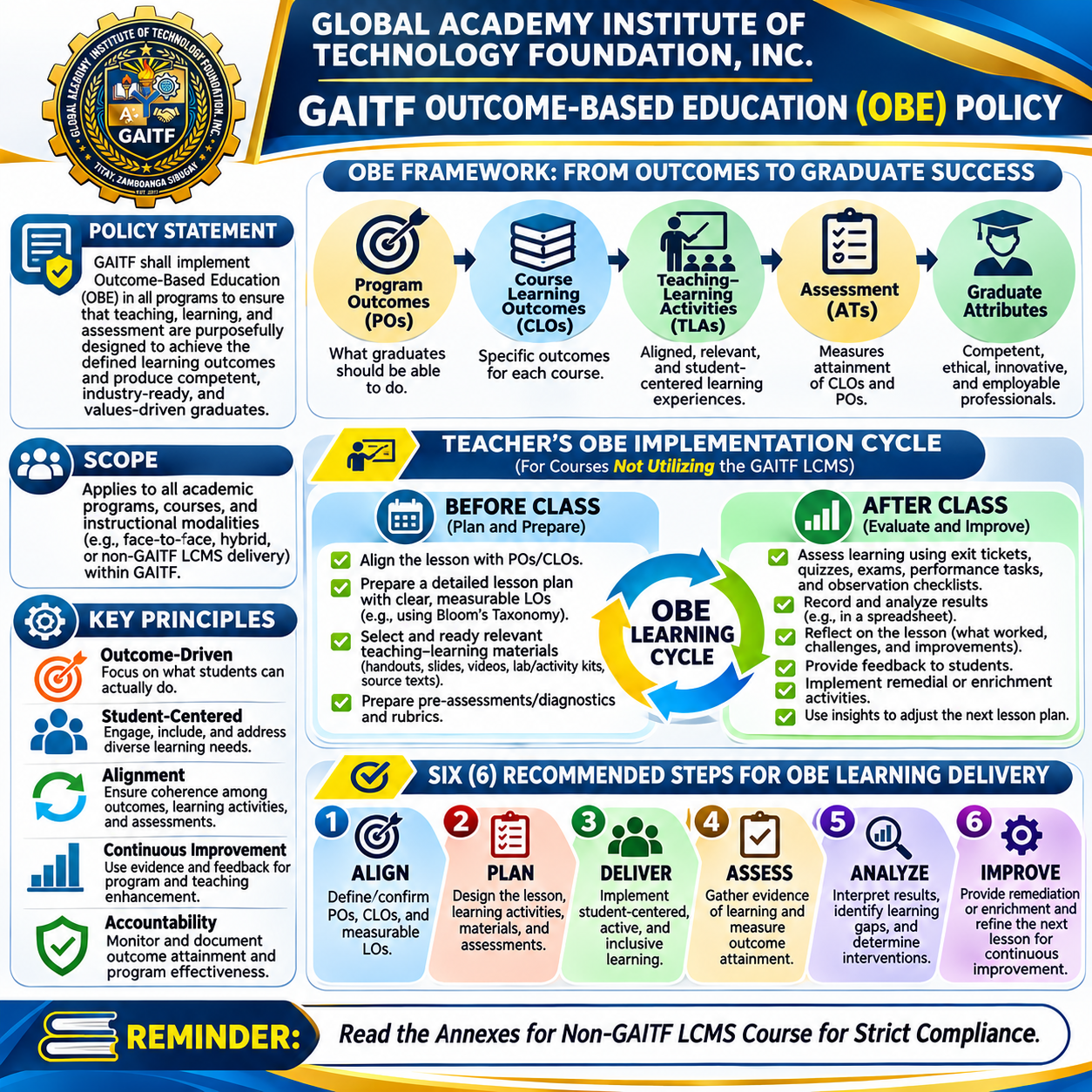
THE GAITF BEFORE–DURING–AFTER LEARNING CYCLE
1. BEFORE CLASS – PREPARE
- Review curriculum and learning competencies.
- Develop measurable learning objectives.
- Prepare lesson plans and instructional strategies.
- Develop learning resources.
- Prepare assessment instruments.
- Upload materials to GAITF LCMS.
- Identify student learning needs.
2. DURING CLASS – DELIVER
- Communicate learning objectives.
- Facilitate instruction and demonstrations.
- Encourage active learning.
- Conduct guided and independent activities.
- Integrate technology and LCMS resources.
- Conduct formative assessment.
- Provide immediate feedback.
3. AFTER CLASS – EVALUATE
- Assess student outputs.
- Evaluate learning outcomes.
- Record student performance.
- Provide constructive feedback.
- Identify learning gaps.
- Conduct remediation or enrichment.
- Update GAITF LCMS records.
4. CONTINUOUS IMPROVEMENT – ENHANCE
- Analyze student performance.
- Reflect on instructional effectiveness.
- Revise teaching strategies.
- Improve learning materials.
- Collaborate with fellow teachers.
- Prepare for the next instructional cycle.
INSTITUTIONAL PRINCIPLE:
Teaching is not merely the delivery of lessons. It is the systematic preparation, facilitation, assessment, documentation, and continuous improvement of student learning outcomes.
GLOBAL ACADEMY INSTITUTE OF TECHNOLOGY FOUNDATION, INC.
Quality Instruction. Measurable Outcomes. Continuous Learning.
FORM 1. Teacher Instructional Compliance Monitoring Form
DOCUMENT CODE: GAITF-ACAD-FRM-001
Purpose: To monitor whether teachers fulfill their instructional responsibilities before, during, and after classroom instruction.
GLOBAL ACADEMY INSTITUTE OF TECHNOLOGY FOUNDATION, INC.
TEACHER INSTRUCTIONAL COMPLIANCE MONITORING FORM
Document Code: GAITF-ACAD-FRM-001
Monitoring Period: __________________
A. TEACHER INFORMATION
- Teacher’s Name: __________________________________
- Department/Program: ______________________________
- Subject/Course: ___________________________________
- Grade Level/Year Level: ____________________________
- Academic Coordinator: _____________________________
- Date of Monitoring: _______________________________
B. BEFORE CLASS – INSTRUCTIONAL PREPARATION
| No. | Monitoring Criteria | Compliant | Non-Compliant | N/A |
|---|---|---|---|---|
| 1 | Updated course syllabus or training plan | ☐ | ☐ | ☐ |
| 2 | Prepared lesson plan | ☐ | ☐ | ☐ |
| 3 | Clearly defined learning objectives | ☐ | ☐ | ☐ |
| 4 | Prepared instructional materials | ☐ | ☐ | ☐ |
| 5 | Learning activities and exercises prepared | ☐ | ☐ | ☐ |
| 6 | Assessment instruments prepared | ☐ | ☐ | ☐ |
| 7 | Rubrics and scoring guides available | ☐ | ☐ | ☐ |
| 8 | Learning resources uploaded to GAITF LCMS | ☐ | ☐ | ☐ |
| 9 | References and supplementary materials available | ☐ | ☐ | ☐ |
| 10 | Differentiated learning strategies considered | ☐ | ☐ | ☐ |
C. DURING CLASS – LEARNING DELIVERY
| No. | Monitoring Criteria | Compliant | Non-Compliant | N/A |
|---|---|---|---|---|
| 1 | Learning objectives communicated to students | ☐ | ☐ | ☐ |
| 2 | Lesson is aligned with the approved curriculum | ☐ | ☐ | ☐ |
| 3 | Appropriate teaching strategies utilized | ☐ | ☐ | ☐ |
| 4 | Students actively participate in activities | ☐ | ☐ | ☐ |
| 5 | Learning materials properly utilized | ☐ | ☐ | ☐ |
| 6 | Practical or application-based activities conducted | ☐ | ☐ | ☐ |
| 7 | Formative assessment conducted | ☐ | ☐ | ☐ |
| 8 | Student understanding monitored | ☐ | ☐ | ☐ |
| 9 | Constructive feedback provided | ☐ | ☐ | ☐ |
| 10 | Classroom environment maintained effectively | ☐ | ☐ | ☐ |
D. AFTER CLASS – ASSESSMENT AND DOCUMENTATION
| No. | Monitoring Criteria | Compliant | Non-Compliant | N/A |
|---|---|---|---|---|
| 1 | Student outputs evaluated | ☐ | ☐ | ☐ |
| 2 | Assessment results recorded | ☐ | ☐ | ☐ |
| 3 | Student feedback provided | ☐ | ☐ | ☐ |
| 4 | Learning gaps identified | ☐ | ☐ | ☐ |
| 5 | Remediation conducted when necessary | ☐ | ☐ | ☐ |
| 6 | Enrichment activities provided when appropriate | ☐ | ☐ | ☐ |
| 7 | GAITF LCMS records updated | ☐ | ☐ | ☐ |
| 8 | Lesson reflection completed | ☐ | ☐ | ☐ |
| 9 | Student progress monitored | ☐ | ☐ | ☐ |
| 10 | Preparation for succeeding lessons undertaken | ☐ | ☐ | ☐ |
E. MONITORING SUMMARY
- Total Applicable Criteria: __________
- Compliant Items: __________
- Non-Compliant Items: __________
- Not Applicable Items: __________
Compliance Percentage:
Compliant Items ÷ Applicable Criteria × 100
Result: __________ %
F. OBSERVATIONS AND RECOMMENDATIONS
Strengths Observed:
Areas for Improvement:
Recommended Corrective Actions:
Target Date for Compliance: ______________________
G. ACKNOWLEDGMENT
Teacher’s Signature: __________________ Date: ______
Academic Coordinator: ________________ Date: ______
Head of Academic Affairs: ______________ Date: ______
Note: This monitoring form is intended for instructional quality assurance, professional development, and institutional compliance monitoring.
FORM 2. Weekly Lesson Preparation and Delivery Report
DOCUMENT CODE: GAITF-ACAD-FRM-002
Purpose: To ensure that every teacher plans, delivers, assesses, and documents instruction on a weekly basis.
GLOBAL ACADEMY INSTITUTE OF TECHNOLOGY FOUNDATION, INC.
WEEKLY LESSON PREPARATION AND DELIVERY REPORT
Document Code: GAITF-ACAD-FRM-002
A. TEACHER INFORMATION
- Teacher: ______________________________________
- Department: ___________________________________
- Subject/Course: ________________________________
- Grade/Year Level: ______________________________
- Week Covered: __________________________________
- Academic Year: __________________________________
B. WEEKLY INSTRUCTIONAL PLAN
| Day/Date | Topic/Lesson | Learning Objectives | Learning Activities | Assessment |
|---|---|---|---|---|
| Monday | ||||
| Tuesday | ||||
| Wednesday | ||||
| Thursday | ||||
| Friday | ||||
| Saturday (if applicable) |
C. INSTRUCTIONAL MATERIALS PREPARED
Check all that apply:
- ☐ Lesson plans
- ☐ PowerPoint presentations
- ☐ Learning modules
- ☐ Reading materials
- ☐ Worksheets
- ☐ Laboratory activities
- ☐ Demonstration guides
- ☐ Instructional videos
- ☐ Online references
- ☐ Quizzes and examinations
- ☐ Performance assessment tools
- ☐ Rubrics and scoring guides
- ☐ Other: ___________________________
D. GAITF LCMS UTILIZATION
| LCMS Activity | Completed | Pending | Not Applicable |
|---|---|---|---|
| Learning materials uploaded | ☐ | ☐ | ☐ |
| Learning resources organized by topic | ☐ | ☐ | ☐ |
| Learning activities published | ☐ | ☐ | ☐ |
| Assignments provided | ☐ | ☐ | ☐ |
| Online quizzes administered | ☐ | ☐ | ☐ |
| Student submissions monitored | ☐ | ☐ | ☐ |
| Assessment results recorded | ☐ | ☐ | ☐ |
| Feedback provided | ☐ | ☐ | ☐ |
E. WEEKLY STUDENT PERFORMANCE SUMMARY
- Total Enrolled Students: __________
- Students Present/Participating: __________
- Students Who Completed Activities: __________
- Students Who Achieved Expected Outcomes: __________
- Students Requiring Remediation: __________
F. INSTRUCTIONAL CHALLENGES
Identify challenges encountered during the week:
- ☐ Internet connectivity
- ☐ LCMS access or technical issues
- ☐ Insufficient learning materials
- ☐ Student absenteeism
- ☐ Student learning difficulties
- ☐ Insufficient equipment or facilities
- ☐ Time constraints
- ☐ Other: ___________________________
Explanation:
G. TEACHER’S WEEKLY REFLECTION
- Were the intended learning objectives achieved?
- Which instructional strategies were effective?
- What learning difficulties were observed?
- What interventions were implemented?
- What improvements will be made next week?
H. CERTIFICATION
I certify that the information provided in this report accurately reflects my instructional preparation, learning delivery, assessment activities, and student learning monitoring for the reporting period.
Teacher’s Signature: __________________ Date: ______
Reviewed by Academic Coordinator:
____________________________ Date: __________
Submission Schedule: Every Friday or the last scheduled instructional day of the week.
FORM 3. Monthly Teacher OBE Performance Evaluation Form
DOCUMENT CODE: GAITF-ACAD-FRM-003
Purpose: To evaluate teacher performance based on instructional preparation, learning delivery, assessment, LCMS utilization, and achievement of student learning outcomes.
GLOBAL ACADEMY INSTITUTE OF TECHNOLOGY FOUNDATION, INC.
MONTHLY TEACHER OBE PERFORMANCE EVALUATION FORM
Document Code: GAITF-ACAD-FRM-003
A. TEACHER INFORMATION
- Teacher: ______________________________________
- Department/Program: ____________________________
- Subject/Course: ________________________________
- Evaluation Month: ______________________________
- Evaluator: _____________________________________
B. PERFORMANCE RATING SCALE
| Rating | Description |
|---|---|
| 5 | Outstanding |
| 4 | Very Satisfactory |
| 3 | Satisfactory |
| 2 | Needs Improvement |
| 1 | Unsatisfactory |
C. PERFORMANCE EVALUATION
1. Instructional Preparation and Planning – 20%
| Indicators | Rating (1–5) |
|---|---|
| Lesson plans are prepared and updated | |
| Learning objectives are measurable | |
| Instruction aligns with curriculum requirements | |
| Instructional activities are properly organized | |
| Assessment instruments are prepared in advance |
Average Rating: ______
Weighted Score: Average ÷ 5 × 20 = ______
2. Quality and Availability of Learning Resources – 20%
| Indicators | Rating (1–5) |
|---|---|
| Learning materials are complete and relevant | |
| Materials are appropriate to student learning levels | |
| References and supplementary resources are provided | |
| Learning materials are accessible to students | |
| Instructional materials are properly organized |
Average Rating: ______
Weighted Score: Average ÷ 5 × 20 = ______
3. Instructional Delivery and Student Engagement – 20%
| Indicators | Rating (1–5) |
|---|---|
| Teaching strategies are effective | |
| Students actively participate | |
| Practical and application-based activities are conducted | |
| Classroom interaction is encouraged | |
| Learning objectives are clearly communicated |
Average Rating: ______
Weighted Score: Average ÷ 5 × 20 = ______
4. Assessment, Feedback, and Evaluation – 20%
| Indicators | Rating (1–5) |
|---|---|
| Appropriate assessments are administered | |
| Assessment tools measure intended outcomes | |
| Student performance is accurately recorded | |
| Constructive feedback is provided | |
| Remediation and enrichment are implemented |
Average Rating: ______
Weighted Score: Average ÷ 5 × 20 = ______
5. GAITF LCMS Utilization and Documentation – 10%
| Indicators | Rating (1–5) |
|---|---|
| Assigned courses are maintained | |
| Learning resources are uploaded | |
| Digital learning activities are utilized appropriately | |
| Assessment and student progress are documented | |
| LCMS records are updated |
Average Rating: ______
Weighted Score: Average ÷ 5 × 10 = ______
6. Reflection and Learning Intervention – 10%
| Indicators | Rating (1–5) |
|---|---|
| Instructional effectiveness is evaluated | |
| Student learning gaps are identified | |
| Learning interventions are documented | |
| Instructional improvements are implemented | |
| Professional development is pursued |
Average Rating: ______
Weighted Score: Average ÷ 5 × 10 = ______
D. OVERALL PERFORMANCE RESULT
| Performance Area | Maximum Weight | Actual Score |
|---|---|---|
| Instructional Preparation | 20 | |
| Learning Resources | 20 | |
| Instructional Delivery | 20 | |
| Assessment and Evaluation | 20 | |
| LCMS Utilization | 10 | |
| Reflection and Intervention | 10 | |
| TOTAL | 100 |
E. PERFORMANCE CLASSIFICATION
| Final Score | Classification |
|---|---|
| 90–100 | Outstanding |
| 85–89 | Very Satisfactory |
| 80–84 | Satisfactory |
| 70–79 | Needs Improvement |
| Below 70 | Unsatisfactory |
F. EVALUATOR’S COMMENTS
Strengths:
Areas for Improvement:
Recommended Professional Development:
Required Corrective Actions:
G. ACKNOWLEDGMENT
Teacher: __________________________ Date: ______
Evaluator: _________________________ Date: ______
Head of Academic Affairs: ____________ Date: ______
Important: This evaluation is a quality assurance instrument. Student achievement must be interpreted in consideration of student starting levels, attendance, learning opportunities, and other relevant factors. Ratings shall be supported by documented evidence and established institutional procedures.
FORM 4. GAITF LCMS Course Readiness Inspection Checklist
DOCUMENT CODE: GAITF-ACAD-FRM-004
Purpose: To verify that each teacher’s assigned GAITF LCMS course is properly established, organized, populated with learning materials, and ready for student utilization.
GLOBAL ACADEMY INSTITUTE OF TECHNOLOGY FOUNDATION, INC.
GAITF LCMS COURSE READINESS INSPECTION CHECKLIST
Document Code: GAITF-ACAD-FRM-004
A. COURSE INFORMATION
- Teacher: ______________________________________
- Course/Subject: ________________________________
- Department/Program: ____________________________
- Academic Year: _________________________________
- LCMS Course Name: ______________________________
- Inspection Date: _______________________________
- Inspector: _____________________________________
B. COURSE SETUP AND ACCESSIBILITY
| No. | Inspection Criteria | Yes | No | N/A |
|---|---|---|---|---|
| 1 | Teacher has an active GAITF LCMS account | ☐ | ☐ | ☐ |
| 2 | Assigned course is created and accessible | ☐ | ☐ | ☐ |
| 3 | Course title and description are correct | ☐ | ☐ | ☐ |
| 4 | Correct students are enrolled | ☐ | ☐ | ☐ |
| 5 | Course structure is properly organized | ☐ | ☐ | ☐ |
| 6 | Students can access the learning materials | ☐ | ☐ | ☐ |
C. COURSE CONTENT AND LEARNING RESOURCES
| No. | Required Course Content | Available | Missing | N/A |
|---|---|---|---|---|
| 1 | Course orientation | ☐ | ☐ | ☐ |
| 2 | Course syllabus/training plan | ☐ | ☐ | ☐ |
| 3 | Course learning outcomes | ☐ | ☐ | ☐ |
| 4 | Learning modules | ☐ | ☐ | ☐ |
| 5 | Presentation materials | ☐ | ☐ | ☐ |
| 6 | Reading materials/references | ☐ | ☐ | ☐ |
| 7 | Instructional videos/media | ☐ | ☐ | ☐ |
| 8 | Worksheets and exercises | ☐ | ☐ | ☐ |
| 9 | Learning activities | ☐ | ☐ | ☐ |
| 10 | Assignments and projects | ☐ | ☐ | ☐ |
D. ASSESSMENT AND EVALUATION
| No. | Assessment Components | Available | Missing | N/A |
|---|---|---|---|---|
| 1 | Diagnostic assessment | ☐ | ☐ | ☐ |
| 2 | Formative quizzes | ☐ | ☐ | ☐ |
| 3 | Summative assessment | ☐ | ☐ | ☐ |
| 4 | Performance-based assessments | ☐ | ☐ | ☐ |
| 5 | Rubrics and scoring criteria | ☐ | ☐ | ☐ |
| 6 | Student submission activities | ☐ | ☐ | ☐ |
| 7 | Feedback mechanisms | ☐ | ☐ | ☐ |
E. STUDENT PROGRESS MONITORING
| No. | Monitoring Features/Practices | Available | Missing | N/A |
|---|---|---|---|---|
| 1 | Student participation monitoring | ☐ | ☐ | ☐ |
| 2 | Activity completion monitoring | ☐ | ☐ | ☐ |
| 3 | Assessment results monitoring | ☐ | ☐ | ☐ |
| 4 | Student feedback and communication | ☐ | ☐ | ☐ |
| 5 | Remediation and enrichment resources | ☐ | ☐ | ☐ |
F. COURSE READINESS RATING
- Total Applicable Criteria: __________
- Compliant Criteria: __________
- Missing Criteria: __________
Readiness Percentage:
Compliant Criteria ÷ Applicable Criteria × 100
Result: __________ %
G. INSPECTION CLASSIFICATION
| Percentage | Status |
|---|---|
| 90–100% | Fully Ready |
| 80–89% | Ready with Minor Improvements |
| 70–79% | Needs Improvement |
| Below 70% | Not Yet Ready |
H. FINDINGS AND REQUIRED ACTIONS
Missing Materials:
Technical Issues:
Required Improvements:
Deadline for Compliance: ________________________
I. INSPECTION CERTIFICATION
Inspector: __________________________ Date: ______
Teacher: ____________________________ Date: ______
Academic Coordinator: _______________ Date: ______
Inspection shall be based on actual course availability, instructional quality, student accessibility, and relevant evidence. Features unavailable in the installed LCMS configuration shall be marked N/A or evaluated through an approved alternative.
FORM 5. Teacher Instructional Improvement Notice
DOCUMENT CODE: GAITF-ACAD-FRM-005
Purpose: To formally notify teachers of identified instructional deficiencies and provide a structured opportunity for correction, assistance, and professional improvement.
GLOBAL ACADEMY INSTITUTE OF TECHNOLOGY FOUNDATION, INC.
TEACHER INSTRUCTIONAL IMPROVEMENT NOTICE
Document Code: GAITF-ACAD-FRM-005
Classification: Confidential – For Official Institutional Use
A. TEACHER INFORMATION
- Teacher’s Name: ________________________________
- Department/Program: ____________________________
- Subject/Course: ________________________________
- Date of Notice: _________________________________
- Issued by: _____________________________________
- Reference Monitoring Report: ____________________
B. REASON FOR ISSUANCE
Please check the applicable instructional deficiency:
- ☐ Failure to prepare or submit lesson plans.
- ☐ Incomplete instructional materials.
- ☐ Failure to provide learning resources.
- ☐ Non-utilization of GAITF LCMS without approved justification.
- ☐ Incomplete LCMS course content.
- ☐ Failure to conduct appropriate learning activities.
- ☐ Inadequate assessment and evaluation.
- ☐ Failure to record student performance.
- ☐ Failure to provide student feedback.
- ☐ Failure to implement necessary remediation.
- ☐ Failure to submit required instructional reports.
- ☐ Other: ______________________________________
C. DESCRIPTION OF OBSERVED DEFICIENCIES
Provide specific facts, dates, monitoring results, and supporting evidence.
D. REQUIRED CORRECTIVE ACTIONS
| Identified Deficiency | Required Improvement | Target Date |
|---|---|---|
E. INSTITUTIONAL SUPPORT TO BE PROVIDED
The institution may provide the following assistance:
- ☐ GAITF LCMS technical orientation.
- ☐ Instructional planning assistance.
- ☐ OBE lesson development training.
- ☐ Assessment and rubric development training.
- ☐ Digital instructional material development.
- ☐ Peer mentoring.
- ☐ Classroom observation and coaching.
- ☐ Other: ______________________________________
Assigned Support Personnel: ______________________
Scheduled Assistance Date: _______________________
F. TEACHER’S EXPLANATION
The teacher is given an opportunity to explain the circumstances surrounding the findings.
G. INSTRUCTIONAL IMPROVEMENT PLAN
| Improvement Objective | Action to be Undertaken | Evidence of Completion | Deadline |
|---|---|---|---|
H. FOLLOW-UP MONITORING
Date of Follow-up: _______________________________
Monitoring Result:
- ☐ Corrective actions completed.
- ☐ Partially completed.
- ☐ Not yet completed.
- ☐ Additional assistance required.
Evaluator’s Remarks:
I. FINAL RECOMMENDATION
- ☐ Close the improvement notice.
- ☐ Extend the improvement period.
- ☐ Provide additional professional development.
- ☐ Refer to the appropriate institutional authority for further review.
J. ACKNOWLEDGMENT AND RECEIPT
I acknowledge receipt of this notice. My signature confirms receipt and discussion of the findings and does not necessarily signify agreement with every finding.
Teacher’s Signature: __________________ Date: ______
Issuing Officer: _______________________ Date: ______
Head of Academic Affairs: ______________ Date: ______
Important: This notice is an instructional improvement and administrative documentation instrument. It is not automatically a disciplinary sanction. Any subsequent administrative action must follow applicable institutional rules, employment agreements, due process, and relevant labor laws.
FORM 6. Student Learning Outcomes Monitoring Report
DOCUMENT CODE: GAITF-ACAD-FRM-006
Purpose: To determine whether students have achieved the intended learning outcomes and competencies, and to provide evidence for instructional improvement.
GLOBAL ACADEMY INSTITUTE OF TECHNOLOGY FOUNDATION, INC.
STUDENT LEARNING OUTCOMES MONITORING REPORT
Document Code: GAITF-ACAD-FRM-006
A. COURSE AND CLASS INFORMATION
- Department/Program: ____________________________
- Subject/Course: ________________________________
- Teacher: ______________________________________
- Grade/Year Level: ______________________________
- Academic Year: _________________________________
- Reporting Period: ______________________________
- Number of Enrolled Students: ____________________
B. INTENDED LEARNING OUTCOMES
List the expected knowledge, skills, competencies, and attitudes students should demonstrate.
| No. | Intended Learning Outcome / Competency | Assessment Method |
|---|---|---|
| 1 | ||
| 2 | ||
| 3 | ||
| 4 | ||
| 5 |
C. STUDENT ACHIEVEMENT DATA
| Learning Outcome | Students Assessed | Students Meeting Target | Students Not Yet Meeting Target | Achievement Rate |
|---|---|---|---|---|
| Outcome 1 | ||||
| Outcome 2 | ||||
| Outcome 3 | ||||
| Outcome 4 | ||||
| Outcome 5 |
Achievement Rate Formula:
Students Meeting the Target ÷ Students Assessed × 100
D. STUDENT LEARNING OUTCOME CLASSIFICATION
| Achievement Rate | Interpretation |
|---|---|
| 90–100% | Very High Achievement |
| 80–89% | High Achievement |
| 70–79% | Developing Achievement |
| 60–69% | Low Achievement |
| Below 60% | Critical Learning Gap |
These are suggested institutional monitoring bands, not automatic grading or competency certification standards. Applicable curriculum, assessment, and awarding-body requirements shall prevail.
E. STUDENT LEARNING GAP ANALYSIS
Identify the competencies or learning objectives where students demonstrated difficulty.
| Identified Learning Gap | Possible Cause | Number of Students Affected |
|---|---|---|
Possible contributing factors:
- ☐ Inadequate prior knowledge.
- ☐ Insufficient practice.
- ☐ Difficulty understanding lesson concepts.
- ☐ Inadequate instructional materials.
- ☐ Irregular attendance.
- ☐ Limited access to learning resources.
- ☐ Insufficient instructional time.
- ☐ Assessment difficulties.
- ☐ Other: ___________________________
F. REMEDIATION AND INTERVENTION PLAN
| Learning Gap | Intervention Strategy | Target Students | Schedule | Expected Outcome |
|---|---|---|---|---|
Possible intervention strategies:
- Additional learning sessions.
- Individualized instruction.
- Peer tutoring.
- Guided exercises.
- Demonstrations.
- Supplemental learning modules.
- Additional laboratory practice.
- Reassessment.
- Other appropriate interventions.
G. ENRICHMENT AND ADVANCED LEARNING
Identify students who have achieved the intended outcomes and require additional learning challenges.
| Student/Group | Demonstrated Competency | Enrichment Activity |
|---|---|---|
H. GAITF LCMS LEARNING EVIDENCE
Indicate available supporting records:
- ☐ Uploaded learning modules.
- ☐ Student activity submissions.
- ☐ Online quiz results.
- ☐ Assessment records.
- ☐ Performance task outputs.
- ☐ Student feedback.
- ☐ Remediation records.
- ☐ Other supporting documentation.
Relevant LCMS Course/Module: ______________________
I. INSTRUCTIONAL RECOMMENDATIONS
Based on the assessment results, what instructional improvements should be implemented?
What adjustments should be made to succeeding lessons?
J. SUMMARY AND CONCLUSION
Overall Learning Outcomes Achievement: __________ %
Number of Students Meeting Expected Outcomes: ______
Number of Students Requiring Intervention: __________
General Findings:
Recommended Institutional Action:
K. CERTIFICATION AND REVIEW
Prepared by:
Teacher: __________________________ Date: ______
Reviewed by:
Academic Coordinator: ______________ Date: ______
Noted by:
Head of Academic Affairs: ___________ Date: ______
Submission Schedule: Monthly, quarterly, or at the end of an instructional unit, as determined by the Academic Affairs Office.
All results must be based on actual assessment evidence. Students who have not yet met an outcome must be given appropriate learning support and reassessment opportunities in accordance with applicable academic and competency standards.
Institutional implementation schedule
To make sure these six forms become part of GAITF’s regular academic operations.
| Period | Required Activity | Responsible Office |
|---|---|---|
| Week 1 | Policy orientation and distribution of forms | Academic Affairs |
| Week 1 | Teacher LCMS course inspection | LCMS Administrator |
| Week 2 | Start weekly instructional reporting | Teachers |
| Week 2 | Initial compliance monitoring | Coordinators |
| Week 3 | Instructional coaching and corrections | Academic Affairs |
| Week 4 | First monthly OBE evaluation | Academic Affairs |
| Monthly | Student learning outcomes analysis | Teachers / Coordinators |
GAITF Institutional Reporting Structure
OFFICE OF THE EXECUTIVE DIRECTOR
Institutional oversight and approval
OFFICE OF ACADEMIC AFFAIRS
Policy implementation and quality assurance
ACADEMIC COORDINATORS / PROGRAM HEADS
Monitoring, inspection, and evaluation
TEACHERS / TRAINERS
Preparation, delivery, assessment, and reporting
STUDENT LEARNING OUTCOMES
Measured competencies and continuous improvement